ASML beats forecasts and lifts 2026 outlook as AI keeps chip equipment orders rolling
The Dutch lithography giant posted €9.3bn in sales and €2.9bn profit, raised full-year guidance sharply and will expand EUV capacity 30% to feed the AI boom.
Commentary & Analysis ·
Verified key facts
- ASML reported Q2 2026 net sales of €9.3 billion and net income of €2.9 billion on 15 July, beating analyst estimates, NL Times reported
- Full-year 2026 revenue guidance was raised to €43-45 billion, up from an earlier €36-40 billion range, per Global Banking and Finance
- ASML plans to add 30% to its low-NA EUV capacity of around 65 tools for 2027 and is studying another 30% rise for 2028, per its earnings call
- AI-related investment in advanced logic and DRAM chips is the main demand driver, the company said
- ASML stopped disclosing quarterly bookings from Q1 2026, moving backlog updates to an annual cycle, The Motley Fool transcript shows
The news: a beat on every line and a much bigger 2026
ASML, the Dutch company whose lithography machines are indispensable to advanced chipmaking, comfortably beat expectations for the second quarter of 2026. Total net sales reached €9.3 billion against analyst estimates of €8.8 billion, Global Banking and Finance reported. Net income came in at €2.9 billion, well above the €2.62 billion consensus.
The bigger surprise was the guidance. ASML now expects full-year 2026 net revenue of €43 billion to €45 billion, NL Times reported. That represents a dramatic upgrade from the earlier forecast range of €36 billion to €40 billion, an increase of roughly 16 percent at the midpoint. Shares jumped on the announcement as investors digested the scale of the revision.
Chief executive Christophe Fouquet attributed the momentum to artificial intelligence. Ongoing AI investment is driving demand for advanced logic and memory chips, the company said in its results statement, and that demand is accelerating the shift toward more advanced lithography.
How it works: why AI demand lands on ASML's order book
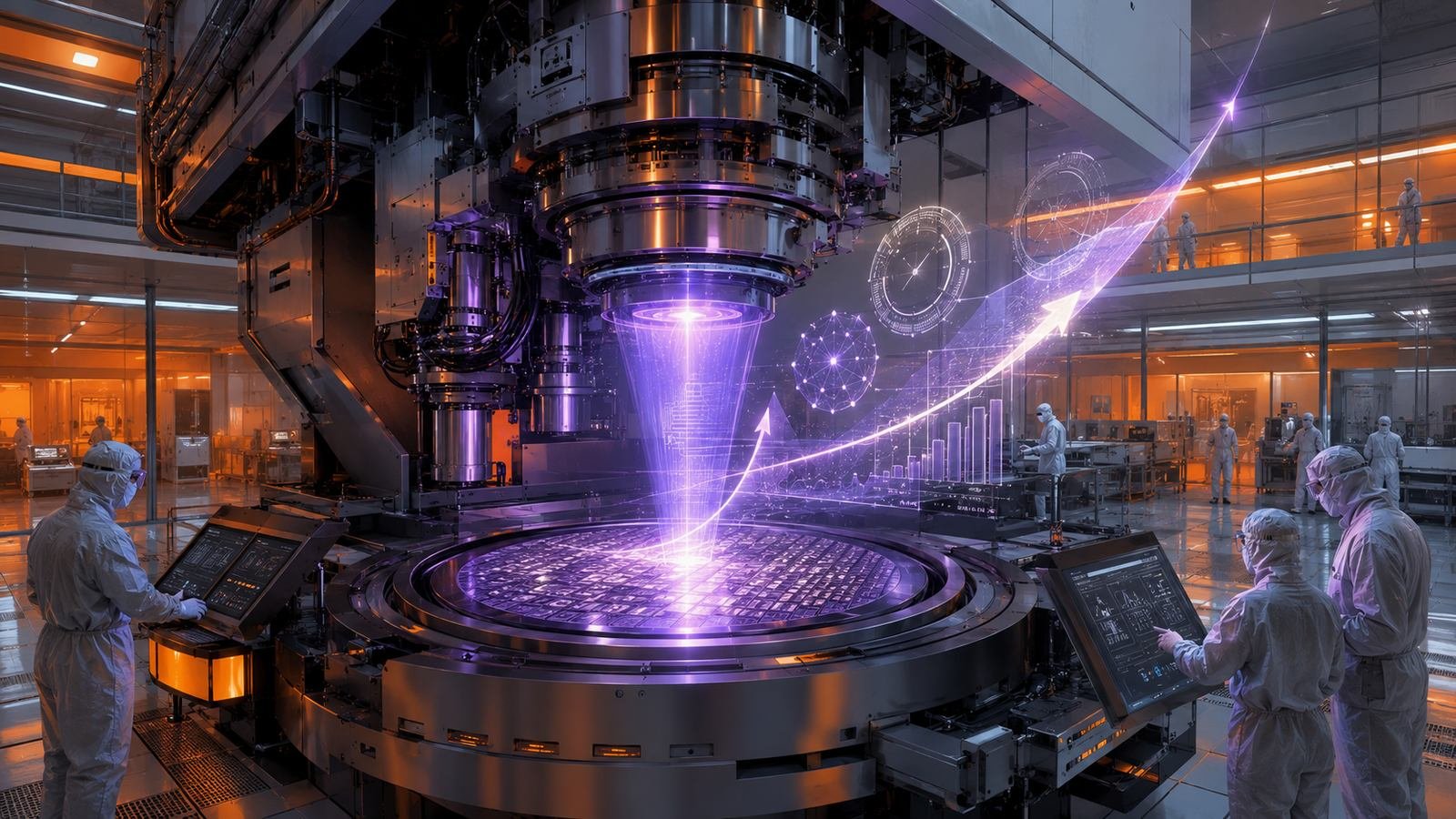
ASML holds a monopoly on extreme ultraviolet lithography, the technology required to print the tiniest chip features. Every advanced AI accelerator from Nvidia, AMD or the cloud giants' custom silicon programmes begins life on an EUV machine. So does the high-bandwidth memory stacked alongside those processors.
The company told investors that AI growth in advanced logic and DRAM is increasing what it calls lithography intensity. Each new generation of chips requires more exposure steps on more advanced tools. That multiplies equipment demand even before any new factories are counted, according to the earnings call transcript published by The Motley Fool.
Customers are responding by racing to book scarce machines. Based on strong first-half order momentum, ASML plans to add 30 percent to its 2027 low-NA EUV capacity, which currently stands at around 65 tools a year. It is also investigating a further 30 percent increase for 2028, the transcript shows.
Industry context: the whole AI supply chain is flashing green
ASML's results opened a pivotal week for semiconductor earnings. A day later, TSMC, its largest customer, posted a record quarterly profit driven by the same AI demand and raised its own full-year outlook. When both the toolmaker and the chipmaker upgrade guidance in the same week, the signal about the cycle is unusually strong.
The results also carry a governance footnote. Starting in the first quarter of 2026, ASML stopped disclosing quarterly bookings and moved backlog reporting to an annual cycle. Management argued that large orders land unevenly across quarters and distort the picture, per the earnings call transcript. Analysts have grumbled that the change removes the industry's favourite forward indicator.
TechTimes had framed this quarter as a test of whether the AI chip boom is sustainable, with EUV demand as the key evidence. The answer, at least for now, is that chipmakers are committing billions of euros to machines that take years to build and decades to depreciate. Those are not the purchasing patterns of a bubble about to deflate quietly.
What it means for chipmakers, cloud buyers and consumers
For chip manufacturers, the message is stark: the queue for EUV tools is lengthening despite capacity expansion. Foundries that fail to secure 2027 and 2028 tool slots now risk ceding advanced-node share to rivals. That dynamic favours the biggest spenders, TSMC, Samsung and SK Hynix, and raises the barrier for everyone else.
For cloud providers and enterprises, more lithography capacity eventually means more AI chips and, in time, less scarcity pricing. The lag is the problem. Tools ordered today ship in years, not months. Compute buyers should expect tight supply to persist through at least 2027 before the current expansion wave reaches production.
Consumers sit at the end of the chain. The same machines that print AI accelerators also print smartphone processors and automotive chips. Sustained competition for tool time keeps advanced silicon expensive, which feeds into device prices. The counterweight is that today's equipment orders are tomorrow's abundant capacity.
What happens next
ASML's upgraded numbers now become the benchmark against which the AI infrastructure trade is measured. The company reports third-quarter results in October, when investors will look for confirmation that the capacity expansion remains on schedule and that demand has not cooled.
- Whether the 2027 EUV capacity expansion of 30% is confirmed and funded in coming quarters
- High-NA EUV adoption as 2-nanometre-class production ramps at TSMC, Samsung and Intel
- Any spillover from US-China export controls, which already restrict ASML's most advanced sales to China
- October's Q3 report as the first test of the new €43-45 billion guidance
Sources
- NL Times - ASML hikes outlook for 2026 as AI keeps driving chip demand; €2.9 billion profit in Q2 (15 July 2026)
- Global Banking and Finance - ASML tops Q2 earnings estimates on strong AI chip demand (15 July 2026)
- The Motley Fool - ASML Q2 2026 earnings call transcript (15 July 2026)
- TechTimes - ASML earnings preview: EUV bookings will show whether the AI chip boom is sustainable (10 July 2026)
You may also like to read
TSMC posts fifth straight record profit and pledges another $100 billion for Arizona
The world's largest chipmaker beat forecasts with a 77% profit surge, booked its first 2nm revenue and raised its 2026 outlook as AI orders keep flooding in.

Russian hackers turned ordinary security cameras into spies on NATO supply routes
Dutch intelligence says Russia-linked hackers hijacked internet-connected cameras to watch military shipments bound for Ukraine, part of a wider European campaign.

Netflix Faces a High-Stakes Q2 Earnings Test as Its $3 Billion Ad Bet Comes Due
Netflix reports second-quarter earnings on 16 July with Wall Street focused on advertising growth, engagement trends and a stock down 21 percent this year.

Apple Intelligence cleared for China launch as regulator approves Alibaba-powered AI
China's cyberspace regulator has registered Apple's generative AI service, ending a 22-month wait and clearing iPhone AI features built on Alibaba's Qwen models.