China's fourth-ranked leader visits Pyongyang as Beijing works to pull North Korea closer
Wang Huning's talks with Workers' Party official Jo Yong Won follow Xi Jinping's June visit, as Beijing counters Pyongyang's deepening alignment with Russia.
Commentary & Analysis ·
Verified key facts
- A Chinese delegation led by Wang Huning, China's fourth-highest-ranked official, arrived in Pyongyang on Wednesday 15 July at North Korea's invitation, KCNA reported.
- Wang met Jo Yong Won, a top Workers' Party official, and affirmed China's will to implement the agreement reached between Xi Jinping and Kim Jong Un in June, Reuters reported.
- Xi's June trip to Pyongyang was his first in seven years, and the Wang visit extends a rapid series of high-level exchanges, the South China Morning Post reported.
- Jo told Wang that North Korea seeks to develop 'strategic communication and tactical cooperation' with Beijing, according to KCNA cited by UPI and the Korea Times.
- The visit coincides with the 65th anniversary of the China-North Korea friendship treaty and comes amid Pyongyang's deepening military ties with Russia.
A high-level mission to Pyongyang
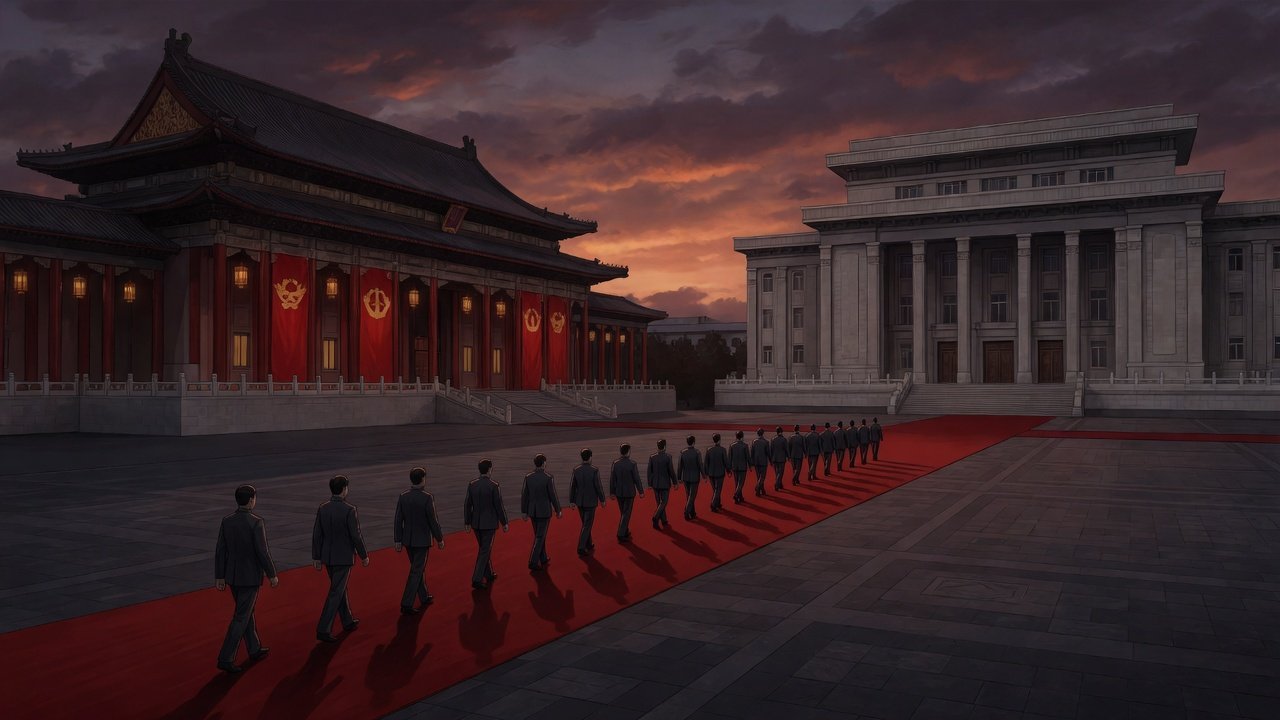
China dispatched one of its most senior leaders to North Korea this week. Wang Huning, ranked fourth in the Communist Party hierarchy and chairman of China's top political advisory body, arrived in Pyongyang on Wednesday at the invitation of the North, according to the state-run Korean Central News Agency, cited by Reuters.
Wang held talks with Jo Yong Won, a top official of the ruling Workers' Party and one of Kim Jong Un's closest aides. KCNA reported the meeting on Thursday. UPI and the Korea Times reported that the two discussed ways to deepen ties between the long-standing allies.
Following through on the Xi-Kim agreement
The visit is explicitly framed as implementation work. At the meeting, Wang affirmed 'the will of the Chinese party and the government' to carry out the agreement reached between President Xi Jinping and Kim Jong Un during Xi's visit to Pyongyang in June, Reuters reported. That trip was Xi's first to North Korea in seven years.
Wang also invoked the 65th anniversary of the two countries' friendship treaty, signed in 1961 and still Beijing's only formal defence pact. Jo responded that North Korea seeks to develop 'strategic communication and tactical cooperation' with China, according to KCNA's account carried by the Korea Times.
Why Beijing is investing in the relationship now
The choreography reflects a deliberate Chinese campaign. The South China Morning Post reported before the trip that visits between the two countries have multiplied, with Wang's mission the most senior since Xi's own. Al Jazeera noted the delegation's arrival extends a series of exchanges unseen in years.
The driver, analysts across the coverage agree, is Russia. Pyongyang has sent troops and munitions to support Moscow's war in Ukraine and received economic and military assistance in return. Reuters reported that Beijing's outreach reflects an effort to reinforce its influence over its traditional ally amid North Korea's deepening ties with Russia.
China supplies the bulk of North Korea's food and fuel and has historically been its indispensable patron. A Pyongyang that can play Moscow against Beijing gains leverage it has not enjoyed since the Cold War. Wang's presence signals that China does not intend to cede that ground.
- Wednesday 15 July: Wang Huning's delegation arrives in Pyongyang at North Korea's invitation
- Talks held with Workers' Party secretary Jo Yong Won, reported by KCNA on 16 July
- Visit follows Xi Jinping's June summit with Kim Jong Un, his first trip in seven years
- 2026 marks 65 years of the China-North Korea friendship treaty
The view from Seoul, Tokyo and Washington
For South Korea's government under President Lee Jae Myung, which has pledged to revive engagement with the North, a Beijing-Pyongyang thaw cuts both ways. Chinese influence could moderate North Korean behaviour, yet closer coordination among China, Russia and North Korea hardens the bloc dynamics Seoul hopes to soften.
Washington and Tokyo watch the same picture with sharper concern. North Korea announced a new uranium enrichment facility in June, and analysts at 38 North assess its weapons-grade material production capacity roughly doubled between 2021 and 2025. Deeper Chinese engagement has not visibly slowed that build-up.
The economic subtext
There are hints Pyongyang is preparing for more Chinese commerce. Daily NK reported this week that North Korean authorities issued a directive to cabinet officials on handling expanded dealings with China, instructing them to pursue economic gains while guarding ideological control. That tension, welcoming Chinese money while fearing Chinese influence, has shaped the relationship for decades.
Sanctions complicate any expansion. UN restrictions still bar most North Korean exports, though enforcement has weakened since Russia vetoed the renewal of the UN expert monitoring panel in 2024. Growing trade across the Yalu River would further blunt the pressure campaign Washington built over a decade.
What to watch next
The immediate questions are whether Wang meets Kim Jong Un before departing and what concrete follow-up emerges from the Xi-Kim agreement, whose contents remain largely undisclosed. Any announcements on trade, border openings or people-to-people exchanges would indicate substance behind the ceremony.
The larger question is strategic balance. If Beijing succeeds in re-anchoring Pyongyang, it gains a managed buffer state and leverage in dealings with Washington and Seoul. If it fails, North Korea drifts further into a transactional partnership with Moscow, with fewer restraints on its weapons programmes than at any point in years.
Sources
- Reuters via US News - Senior Chinese and North Korean officials hold talks in Pyongyang, KCNA reports (15-16 July 2026)
- Al Jazeera - Senior Chinese delegation visits North Korea for talks (16 July 2026)
- UPI - Senior NK party official, top Chinese political adviser discuss ways to deepen ties (16 July 2026)
- South China Morning Post - China's No 4 official Wang Huning to head to North Korea as visits multiply (July 2026)
You may also like to read
Taiwan intelligence says China's Pacific missile was fired from the surface, as island nations demand answers
New testimony in Taipei says China's JL-2 was launched from a surfaced platform, while Australia and Pacific leaders call the 7,300 km test destabilising.

China's economy grows just 4.3% in the second quarter, its weakest pace since late 2022
Official data show Chinese growth slipping below Beijing's 4.5-5% target band, as weak consumption and investment offset an export boom powered by AI demand.

Japan moves to treat crypto like stocks, paving the way for Bitcoin ETFs and a 20% tax
Japan's upper house has backed a landmark bill reclassifying digital assets under securities law, cutting crypto taxes from up to 55% to a flat 20%.
Blind Inspectors, Split Security Council: Diplomacy Strains as Iran Frees US Citizen
The IAEA says it has lost track of Iran's nuclear inventories as the Security Council splits over snapback sanctions, yet a detainee release hints at an opening.