Xi's Purges Have Consumed His Own Loyalists. That Is the Signal to Read.
With five of seven Central Military Commission members purged and verdicts on Zhang Youxia delayed, China's opacity is now a global risk factor.
Commentary & Analysis ·
Verified key facts
- Five of the seven members of China's Central Military Commission have been purged, including vice-chairmen Zhang Youxia and He Weidong, per CSIS analysis.
- He Weidong, Miao Hua and seven other generals were expelled from the party and military in October 2025, per the South China Morning Post.
- Zhang Youxia, first-ranked CMC vice-chairman and Politburo member long seen as a close Xi ally, was detained with Joint Staff chief Liu Zhenli in early 2026, per Foreign Policy and The Diplomat.
- On 26 June 2026 the NPC Standing Committee stripped delegate status from 14 officials, including Politburo member Ma Xingrui and three full generals, while verdicts on Zhang and Liu remain conspicuously delayed, per China Leadership Monitor.
- More than 100 senior PLA officers have been removed or gone missing since 2022, per CSIS.
The purge that ran out of enemies
China's military purge has crossed a threshold that should reframe how the world reads it. By CSIS's count, five of the seven members of the Central Military Commission, the body that commands the People's Liberation Army, have now been purged. He Weidong, the second-ranked general, was expelled from party and army in October 2025 along with Admiral Miao Hua and seven others, per the South China Morning Post. Then, in early 2026, the campaign reached Zhang Youxia, the first-ranked vice-chairman and a man long described as Xi Jinping's closest military ally, per Foreign Policy.
More than 100 senior officers have been removed or vanished from view since 2022, CSIS records. When a purge consumes the loyalists who conducted earlier purges, the standard explanations begin to strain.
What the delayed verdicts reveal
The procedural details are quietly extraordinary. On 26 June, China's legislature stripped delegate status from 14 officials, including Politburo member Ma Xingrui and three full generals, as China Leadership Monitor documented. Zhang and Liu Zhenli, the former Joint Staff chief detained alongside him, were conspicuously absent from that list. Their verdicts have been repeatedly delayed through successive legislative sessions.
In a system that moves swiftly when consensus exists, delay is information. It suggests either contested evidence, contested politics, or fear of the reaction inside the ranks. Analysts noted the unusual speed of Zhang's initial denunciation, days after he missed a study session, as an attempt to pre-empt unrest, per The Diplomat. Speed at the arrest, paralysis at the sentence: that combination describes a leadership managing a problem it has not solved.
The case for the boring explanation
The charitable reading deserves a hearing. PLA corruption is real, vast and decades old, entangled with procurement budgets that exploded during modernisation. On this view, Xi is doing what no predecessor dared: professionalising a rotten institution, accepting short-term disruption for long-term capability. Some analysts argue harsh punishments signal seriousness, not panic, and that a cleaner PLA eventually emerges stronger.
The difficulty is arithmetic. Anti-corruption drives that repeatedly destroy the enforcers of previous rounds stop looking like cleansing and start looking like instability with a legal vocabulary. Xi personally elevated nearly every man he has now destroyed. Either his judgment of people fails at an astonishing rate, or corruption is not the variable that explains the outcomes. Neither reading comforts.
Why the world cannot look away
A churning PLA command is not an internal Chinese matter. It bears directly on questions the world is already anxious about.
- Military readiness: command turnover on this scale disrupts planning, promotion pipelines and joint-operations experience, whatever the official messaging says.
- Signalling risk: outside analysts cannot tell whether purges make adventurism, including toward Taiwan, less likely (disruption) or more likely (diversion).
- Negotiating uncertainty: foreign militaries and diplomats no longer know which Chinese interlocutors will exist next quarter.
- Succession stakes: a leader who distrusts his own marshals has narrowed the circle that could ever manage a transition.
Opacity compounds each risk. The absence of reliable information forces every capital to plan against worst cases, which is how spirals begin.
How democracies should respond
The tempting responses are the wrong ones. Triumphalism, treating PLA disarray as a strategic windfall, invites complacency about a military that remains formidable at every level below the purged summit. Panic, treating the purges as a countdown to war, risks manufacturing the confrontation it fears.
The sober agenda is unglamorous. Keep military-to-military communication channels open and redundant, precisely because China's command roster keeps changing. Invest in independent analysis of PLA politics rather than mirror-imaging assumptions about rational unified actors. And say publicly, consistently, that crisis hotlines and incident protocols serve Beijing's interest most of all when its own chain of command is in flux.
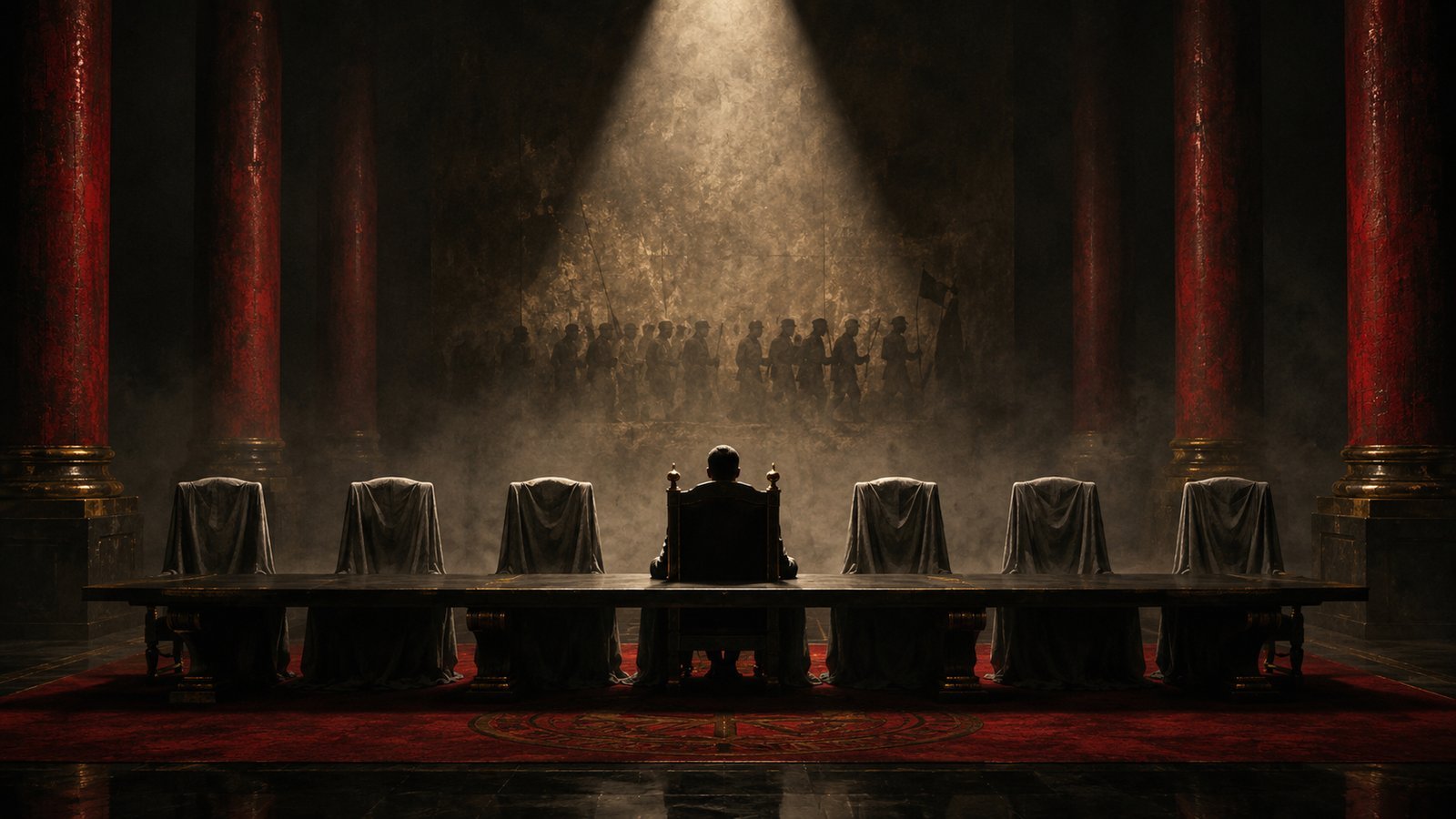
The deepest signal from this purge is about the nature of the system itself. Personalist rule promises decisiveness and delivers, over time, an information vacuum at the top of a nuclear-armed state. Zhang Youxia's empty chair, and the verdict that never quite arrives, tell us the vacuum has reached the commission that would wage China's wars. The world should watch that chair, not the communiques.
Sources
- CSIS - Assessing Xi's unprecedented purges of China's military: key developments and potential implications (2026)
- Foreign Policy - What to know about China's latest military purge (27 January 2026)
- South China Morning Post - China expels He Weidong, Miao Hua and 7 other generals from party and military (October 2025)
- China Leadership Monitor - Why is Xi still purging his generals? (2026)
- The Diplomat - The purge of Zhang Youxia and Liu Zhenli: why, and what's next for China's military (January 2026)
You may also like to read

The Biggest World Cup Ever Is Also the Most Exclusionary. That Is a Choice.
Record attendance and a dream Argentina-Spain final cannot hide it: travel bans and $8,000 tickets have turned a global festival into a gated one.

The Hormuz Crisis Is a Stress Test, and the World's Energy Importers Are Not Ready
As the US-Iran ceasefire unravels and tankers burn in the strait, the heaviest costs fall on importing economies that never built real resilience.

Taiwan intelligence says China's Pacific missile was fired from the surface, as island nations demand answers
New testimony in Taipei says China's JL-2 was launched from a surfaced platform, while Australia and Pacific leaders call the 7,300 km test destabilising.

The Machines Have Wallets Now. Whether We Hand Them Ours Is the Real Test.
Visa, Mastercard and OpenAI have opened payment rails to AI agents. Adoption will hinge not on capability but on liability, audit trails and trust.